Spotlight on SGH - Advanced Analysis
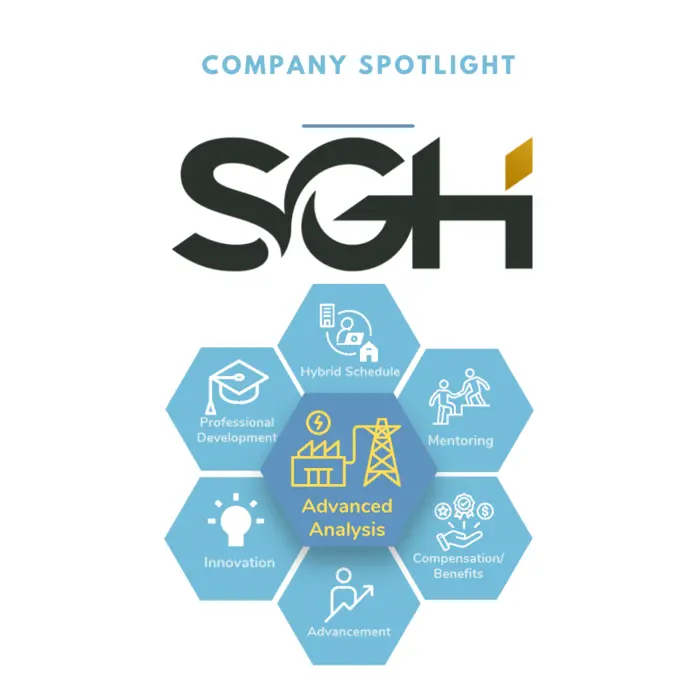
This month, we highlight the engineering challenges of nuclear structural engineering at Simpson Gumpertz & Heger (SGH). The type of project work a firm performs is a key consideration when choosing where to advance your structural engineering career.
Christine Roy, a Senior Project Manager in SGH’s Engineering Mechanics and Infrastructure (EMI) group, did not initially plan a career in nuclear structural engineering. A couple years after joining SGH she saw both the rising demand for clean, sustainable energy and the company’s commitment to addressing it through the nuclear division’s rigorous, sustainable solutions. Today, she leads design projects on nuclear facilities nationwide.
In her recent TEDx talk on a career in Nuclear Energy, Christine shared how she found deep purpose in nuclear structural engineering, especially after confronting the risks and realities exposed by Fukushima. Through that journey, she argues that the future of clean energy depends not just on bold technology, but on designing resilient systems that can withstand the worst day and still make possibility safe. She told SE Careers, “SGH is committed to delivering safe, reliable nuclear structures and supports our active involvement in industry organizations, where we help shape design standards and advance the field.”
Christine explained that structural engineering for nuclear projects extends well beyond conventional building design. Teams work to the advanced requirements of ASCE 4, ASCE 43 and ACI 349, using tools such as SASSI and ANSYS to analyze soil-structure interaction, fatigue, thermal effects, and nonlinear behavior. Nuclear projects typically use steel, concrete, and masonry, but unfamiliar materials may require engineers to work with SGH’s in-house laboratory to develop testing protocols and integrate the results into their models. Safety underpins every stage of this work with multiple points of verification through SGH’s robust quality assurance program, and external peer review. Christine noted that feedback from peer reviewers is often especially valuable as it adds an additional layer of quality to the analysis and design.
Christine shared that while working in the EMI division at SGH, structural engineers can expect:
- Technical depth. The need to understand structural behavior through detailed analysis and conformance to rigorous design requirements.
- Collaboration. Formal and informal mentoring and collaboration supports engineers as they grow.
- Industry Engagement. SGH supports and encourages participation in industry committees.
- Giving back. Employees organize volunteer events, donation drives, and employee resource groups. The company encourages colleagues to make an impact within the organization, and in the communities they live in.
If you’re an experienced engineer with an interest in challenging problems, going beyond standard design requirements, and being part of a team that values both rigor and people, we encourage you to visit the SGH career page on SE Careers for a list of current opportunities.